Which stores share electrical dependencies?
Several stores may depend on the same transformers or substations. We use our own model to assess these dependencies and estimate the availability of alternative supply routes.
Working Group Risk Analysis
We use our internal risk tool to analyse which stores are suitable for mobile emergency power and which should take priority. You determine each store’s strategic importance within your business. Together, we review the findings and decide which stores to prepare and in what order.
We consider site conditions, goods at risk, food supply and logistics.
01 — Store locations
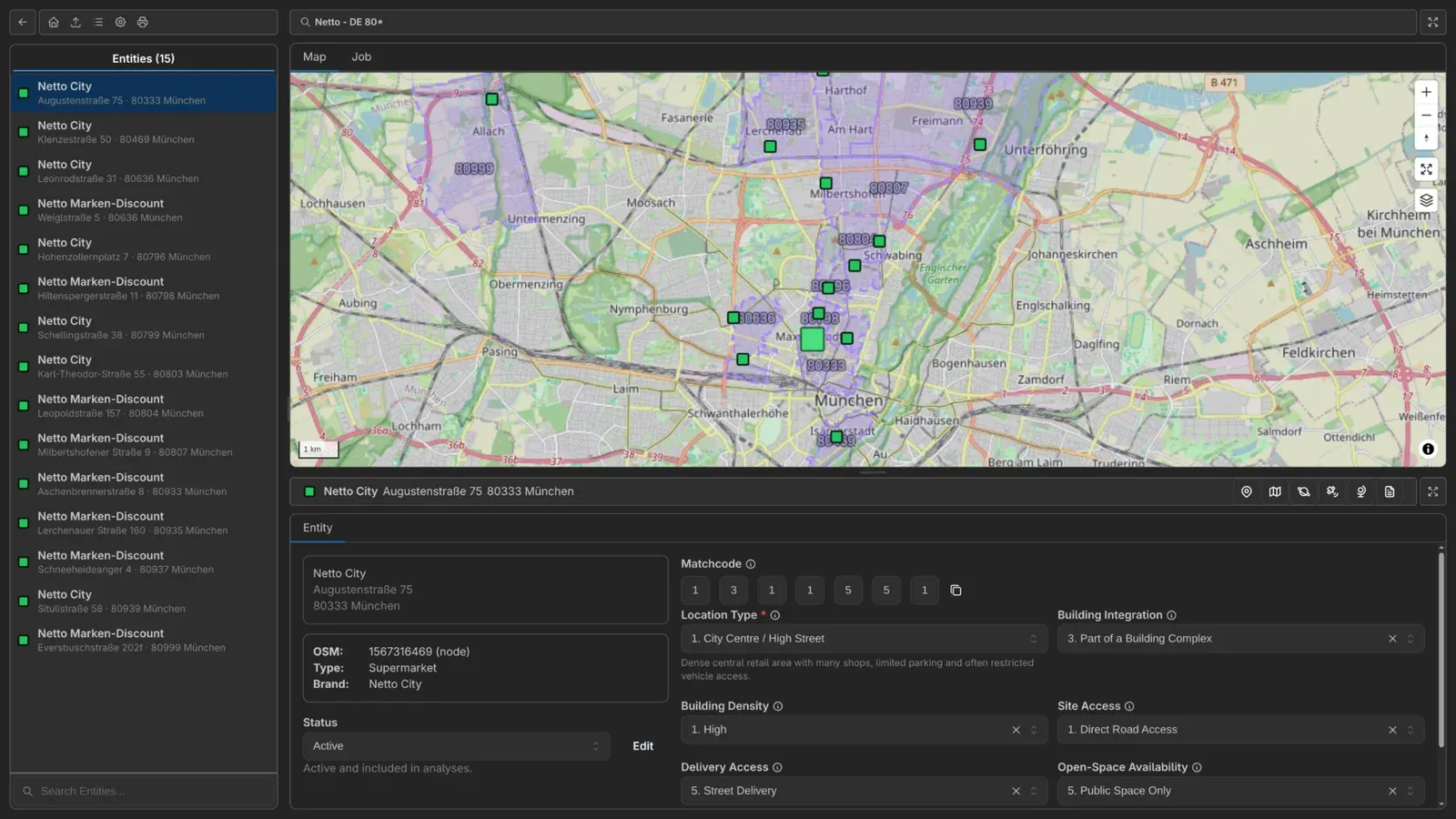
Example: Munich, using public data. Netto stores are used for demonstration purposes. Assessment results are not published.
We can use publicly available store addresses or map your stores in a region from CSV data or an SAP export.
Our site assessment classifies stores by location type, building, access and available space. We use it to assess where mobile emergency power could work and what still needs to be checked on site.
Store selection involves stock, continued trading and local food supply, as well as effort and cost. Different stores may take priority depending on the objective. Our tool provides evidence to help us weigh these options with you.
Only you can determine a store’s strategic importance relative to your other locations. The interests of the property owner, store operator and retail organisation also need to be established.
How many people depend on the store? Which alternatives can they still reach during an outage?
The assessment must establish whether a generator can stand at the site or on the street. Building requirements, cable routes and a suitable connection point must be considered.
Truck access, distance from the equipment base and available units must be established. The plan must also account for several stores being affected at the same time.
The assessment must establish how fuel is stored and replenished, and whether goods can still reach the store if a distribution centre fails.
Who is available on site? How will staff and goods be protected? Risks of looting and unrest must be included in the risk assessment and the overall plan.
Several stores may depend on the same electricity infrastructure and lose power together. This matters when selecting stores to prepare.
For small stores, the cost of technical preparation needs to be weighed against the potential stock loss.
We use these questions and our findings to discuss with you which stores should be prepared and in what order.
02 — Local food supply
When stores become unavailable, demand shifts to the locations that remain accessible. A store that still has power may therefore need to supply more people. We assess the need for emergency power alongside each store’s role in local food supply.
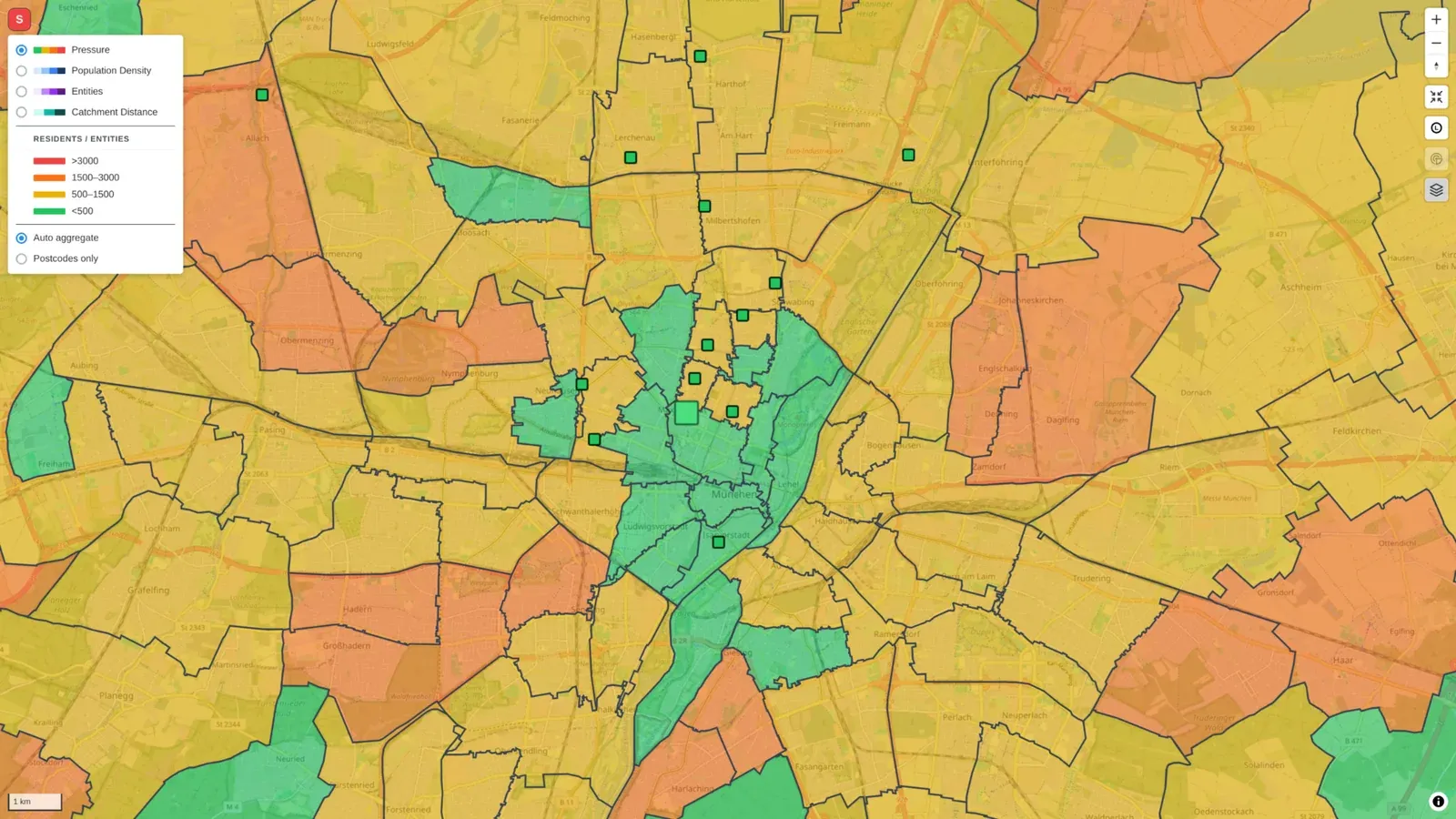
Example: Munich, using public data. Netto stores are used for demonstration purposes. Assessment results are not published.
Our tool compares population with supermarket availability in an area, including stores from other retail chains.
Many people shop while commuting or travel to stores by public transport. An outage can change which stores they can reach. We therefore consider supermarket availability in the city centre, suburbs and surrounding areas, along with available transport routes.
03 — Equipment bases
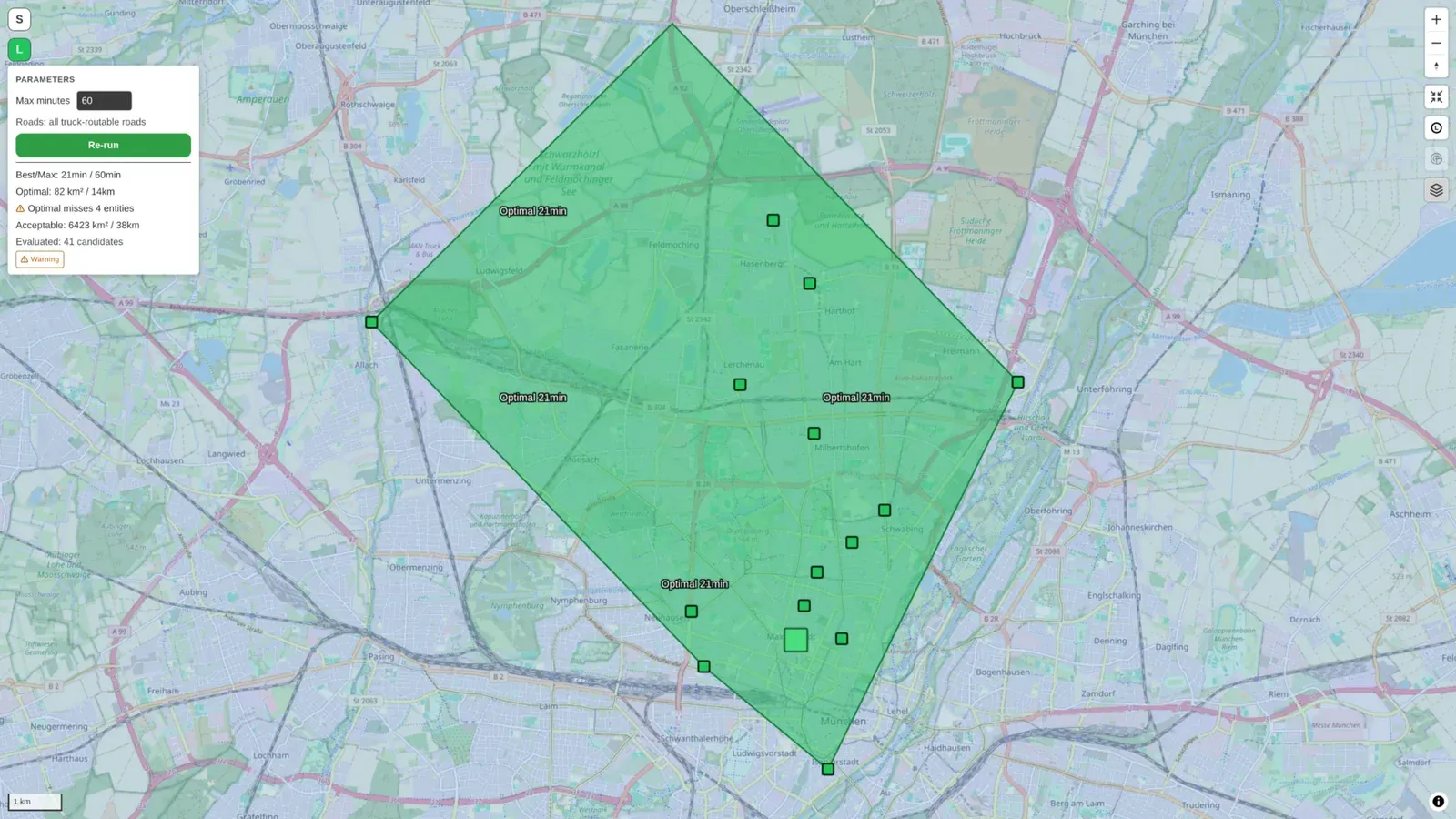
Example: Munich, using public data. Netto stores are used for demonstration purposes. Assessment results are not published.
The logistics module suggests bases using truck travel time to the stores. We assess supermarkets, distribution centres and locations within our wider network as potential bases.
We compare optimal and acceptable areas. We usually use an acceptable planning limit of 60–90 minutes by truck. The base also needs space for equipment and fuel, with storage permitted at the site.
Loading, placement and connection take time in addition to the truck journey. All of these need to be included in deployment planning. In the example shown, four stores lie outside the area marked as optimal.
Several stores may depend on the same transformers or substations. We use our own model to assess these dependencies and estimate the availability of alternative supply routes.
We also use our own model to assess a store’s role in local food supply. This complements the population-to-supermarket comparison.
Our criminologists assess risks of looting and unrest, along with the safety of staff and goods. The findings inform the overall plan and measures at each location.
We assess possible effects of a failure at a major distribution point, such as a 110 kV substation. This includes loss of redundancy or the consequences of an attack. We do not publish screenshots of these sensitive analyses.
We discuss with you which stores should be technically prepared, where mobile units should be based and what still needs to be checked on site. The findings inform the playbook and arrangements with partners.